
Financial Milestones to Think About in Each Decade of Adulthood

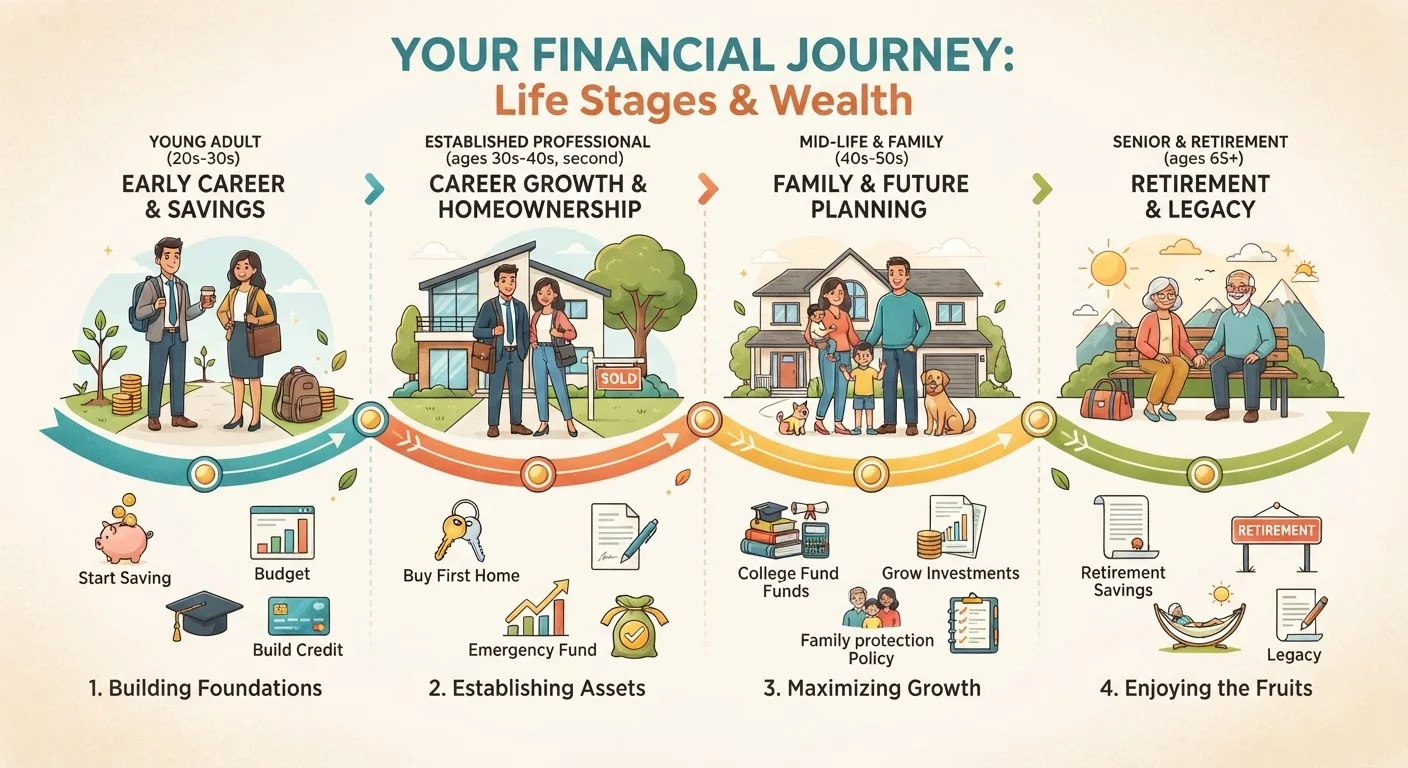
Photo: FaqExplorer.net | Informative Website editorial
Key Takeaways
- Each decade of adulthood brings distinct financial priorities that build on the one before it.
- Starting retirement contributions early - even small ones - can have an outsized long-term impact due to compounding.
- An emergency fund, adequate insurance, and a clear debt strategy are foundational at any life stage.
- Your 50s and 60s are critical windows to review retirement readiness and adjust your savings rate if needed.
- Financial planning is not one-size-fits-all; your specific timeline and circumstances should shape your targets.
Why Thinking in Decades Helps
Personal finance rarely follows a neat script, but thinking about money in roughly ten-year chapters can help you avoid the most common mistake: trying to do everything at once. Each decade tends to carry its own mix of income levels, obligations, and opportunities. Mapping those patterns in advance - even loosely - gives you a useful framework for setting priorities, rather than reacting to financial pressure after the fact.
This article walks through five decades of adulthood, from your 20s through your 60s, and highlights the milestones most worth thinking about in each. It is general financial education, not personalized advice - your own circumstances, income, family situation, and goals will always shape what makes sense for you. For decisions specific to your situation, a licensed financial adviser is the right resource.
Before diving in, it helps to get clear on your broader savings picture. See our savings goals checklist for questions worth answering before you commit to any financial targets.
Your 20s: Build the Foundation
The defining financial opportunity of your 20s is time. Even modest contributions to a retirement account - such as a workplace 401(k) or an individual retirement account (IRA) - have decades to grow through compounding, meaning your returns can generate their own returns. Many financial planners suggest aiming to contribute at least enough to capture any employer match on a 401(k), since unmatched contributions are effectively uncollected compensation.
Alongside retirement basics, two other priorities deserve early attention:
- Emergency fund: A reserve of three to six months' worth of essential living expenses, held in a liquid savings account, acts as a buffer against job loss, unexpected medical costs, or urgent repairs - without resorting to high-interest debt.
- Credit fundamentals: Understanding how credit scores work - payment history, credit utilization, length of history - and building responsible habits early sets up better borrowing options (and lower rates) in future decades.
Student loan repayment is a reality for many people in their 20s. Exploring income-driven repayment options, if applicable, and understanding your loan types can help you manage that obligation while still making forward progress on saving.
Time is the most powerful financial asset in your 20s - even small contributions compound significantly over decades.
Your 30s: Navigate Major Life Transitions
Income often grows in the 30s, but so do expenses - housing, childcare, and lifestyle costs can all expand simultaneously. The core challenge of this decade is directing income growth toward financial goals rather than absorbing it all into a higher-cost lifestyle, a pattern sometimes called lifestyle inflation.
Key milestones to consider in your 30s include:
- Homeownership: For those who want to buy a home, the 30s are a common window. Understanding how much to save, how long it realistically takes, and what affects your timeline is important groundwork. Our piece on saving for a down payment offers a realistic look at that process.
- Adequate insurance coverage: Life insurance, disability insurance, and adequate health coverage become more consequential when others depend on your income.
- Retirement contribution increases: Aim to increase your contribution rate each time your income grows - even a one- or two-percentage-point bump compounds meaningfully over time.
If consumer debt - credit cards, personal loans - accumulated in your 20s, the 30s are a good decade to prioritize eliminating it systematically using a structured repayment approach.
Directing income growth toward goals - rather than lifestyle inflation - is the defining financial discipline of your 30s.
Your 40s: Deepen and Diversify
By your 40s, most people have a clearer picture of their income trajectory and major obligations. This decade is typically a strong window to accelerate savings, particularly for retirement, while also taking stock of what has and hasn't worked financially.
Worthwhile areas of focus in your 40s:
- Retirement savings audit: Review your current account balances against rough benchmarks - many guidelines suggest having roughly three times your annual salary saved by your mid-40s, though these vary by source and individual circumstance. The key is identifying gaps and adjusting your savings rate.
- College funding considerations: For parents, the 40s often involve thinking seriously about how much to contribute toward higher education costs. Tax-advantaged education savings accounts (such as 529 plans) can help, but should not come at the expense of retirement saving.
- Estate planning basics: A will, healthcare directive, and beneficiary designations on financial accounts are foundational documents that many people delay too long.
The 40s can also be a moment to review whether your investment allocations - typically a mix of stocks and bonds in retirement accounts - still match your time horizon and risk tolerance. These are decisions best made with a qualified financial adviser.
Your 40s are a pivotal window to audit retirement progress and fill gaps before the runway shortens.
Your 50s: Intensify Retirement Preparation
The 50s are often described as the critical decade for retirement readiness. You likely have your peak earning years ahead of or around you, and U.S. tax rules allow workers aged 50 and older to make additional "catch-up contributions" to retirement accounts beyond the standard annual limits - a meaningful advantage for those who got a slower start.
Priorities in your 50s:
- Maximize catch-up contributions: If your cash flow allows, taking full advantage of catch-up limits in a 401(k) and/or IRA can materially improve retirement account balances in the years remaining before you stop working.
- Model your retirement income: Begin projecting what your retirement income might look like - Social Security estimates (available through the Social Security Administration), pension income if applicable, and portfolio withdrawals. Understanding the gap between projected income and anticipated expenses helps you calibrate how much more to save.
- Pay down mortgage debt: Entering retirement without a mortgage payment reduces the monthly income you'll need to draw down from savings.
Healthcare costs in retirement are often underestimated. Researching Medicare eligibility, supplemental coverage options, and potential long-term care needs is worth beginning in your 50s, well before decisions become urgent.
Catch-up contribution rules give workers 50 and older a meaningful boost - take full advantage if your budget allows.
Your 60s: Prepare for the Transition
The decade leading into and through retirement is less about accumulation and more about transition - organizing income streams, managing withdrawals, and protecting what you've built. This is typically when the sequencing of financial decisions becomes especially important and the stakes of errors are higher.
Key considerations in your 60s:
- Social Security timing: You can claim Social Security retirement benefits as early as age 62 or as late as 70, with a larger monthly benefit the longer you wait (up to age 70). The right timing depends on health, other income sources, and household circumstances - not a one-size-fits-all answer.
- Required minimum distributions (RMDs): Traditional IRAs and most 401(k) plans require account holders to begin withdrawals at a certain age set by law. Understanding when RMDs begin and how they affect your tax situation matters for planning purposes.
- Portfolio de-risking: As the time horizon for drawing on savings shortens, many people gradually shift their investment mix toward more conservative allocations - though the right balance depends on individual goals and needs.
The emotional and psychological dimensions of retirement - purpose, identity, social connection - are real and worth thinking about alongside the financial ones. Our article on how mental wellness needs shift across the lifespan offers useful perspective on that transition.
Social Security timing, RMD rules, and portfolio de-risking are the three financial levers most worth understanding in your 60s.
Building a Plan That Works Across Time
No single decade exists in isolation. The savings habit you build at 25, the debt you eliminate at 35, and the retirement contributions you accelerate at 50 are all part of a single, continuous arc. One useful framing: short-term needs and long-term goals must coexist rather than compete. Our guide on managing short- and long-term savings goals simultaneously explores practical ways to structure savings so near-term spending does not crowd out future security.
For a more comprehensive view of how all these pieces fit together - from emergency funds to estate basics - the long-term financial planning overview for everyday households is a strong companion resource. Financial milestones are guideposts, not guarantees. The goal is not perfection at every stage; it is steady, informed progress over time.
This article is for general informational and educational purposes only and does not constitute personalized financial, investment, tax, or legal advice. Consult a qualified financial professional before making decisions specific to your situation.
The content on this site is provided for informational purposes only and should not be considered a substitute for professional advice. While we strive to provide accurate and up-to-date information, we make no guarantees regarding its completeness or accuracy. Always consult a qualified professional for advice specific to your circumstances before making any decisions.