
Hardwood vs. Engineered Wood Flooring: What's Actually Different

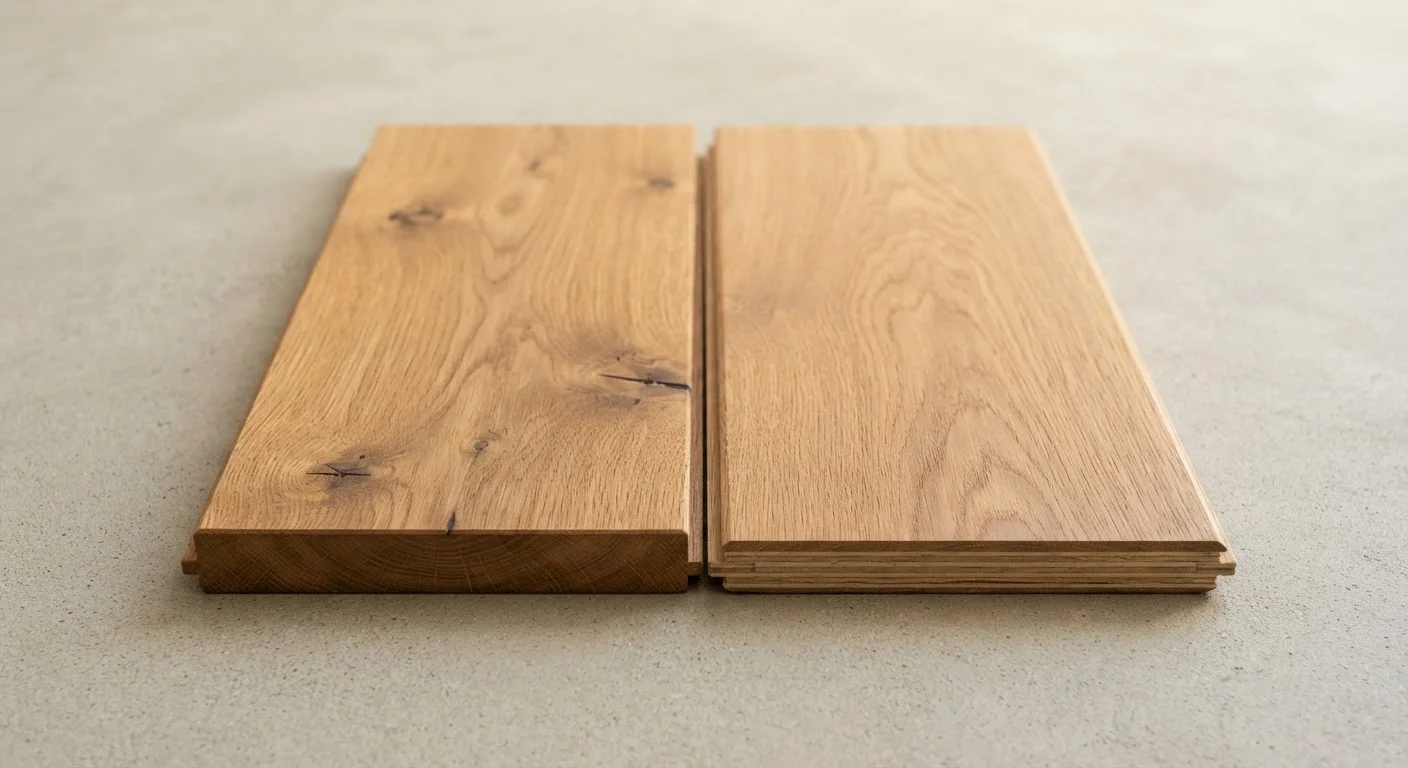
Photo: FaqExplorer.net | Informative Website editorial
Key Takeaways
- Solid hardwood is milled from a single piece of wood and can typically be sanded and refinished three to five times over its life.
- Engineered wood uses a real hardwood veneer bonded over cross-layered plywood, making it significantly more resistant to moisture and movement.
- Neither option is universally superior - installation location, subfloor type, and local climate are the deciding factors.
- Engineered wood can be refinished, but usually only once or twice depending on veneer thickness.
- Both products are available in similar species, stains, and widths, making aesthetic differences minimal to the naked eye.
How They're Actually Built
The most important difference between solid hardwood and engineered wood is structural, not cosmetic. Solid hardwood is exactly what it sounds like - a plank milled from a single piece of timber, typically ¾ inch thick. The grain runs uniformly through the entire board.
Engineered wood, by contrast, is a manufactured product. A thin layer of real hardwood - the veneer, usually 1-6 mm thick - is bonded to multiple layers of cross-grain plywood or high-density fiberboard beneath it. Those alternating layers are the key: they counteract the wood's natural tendency to expand and contract with humidity changes.
This construction difference drives nearly every other distinction between the two products - from where they can be installed to how many times they can be refinished.
| Criterion | Solid Hardwood | Engineered Wood |
|---|---|---|
| Core construction | Single piece of milled timber | Hardwood veneer over cross-ply core |
| Typical thickness | ¾ inch | ⅜ to ¾ inch |
| Moisture resistance | Low - expands and contracts significantly | Moderate to good - stable in humidity |
| Below-grade installation | Not recommended | Generally suitable |
| Over radiant heat | Usually not recommended | Often compatible |
| Refinishing potential | 3-5 times over lifespan | 1-2 times (veneer-dependent) |
| Installation methods | Nail or staple only | Nail, glue, or float |
| Appearance | Authentic grain throughout | Real wood surface, visually identical |
Moisture Resistance and Where You Can Install Each
Wood is a hygroscopic material - it absorbs and releases moisture from the surrounding air, and it moves dimensionally as it does so. Solid hardwood, being one continuous piece, responds dramatically to these changes. In high-humidity environments, planks can swell against one another; in dry conditions, gaps may open between boards. This is why solid hardwood is generally not recommended for below-grade spaces like basements, or directly over concrete slabs where moisture can wick upward.
Engineered wood's cross-ply core significantly reduces that movement. The alternating grain directions in each layer work against each other, limiting overall expansion and contraction. This makes engineered wood viable in basements, over concrete with an appropriate moisture barrier, and in kitchens - spaces where solid hardwood would carry meaningful long-term risk.
Concrete Subfloors Require a Moisture Test
Climate matters even above grade. Homeowners in coastal or high-humidity regions such as the Gulf Coast or Pacific Northwest often find engineered wood performs more reliably in main living areas too, simply because ambient humidity is harder to control year-round.
Refinishing: How Many Times Can You Go Back?
One of solid hardwood's most cited advantages is refinishability. A standard ¾-inch solid plank has enough material above the tongue-and-groove to be sanded down and refinished approximately three to five times across its lifespan - enough to address deep scratches, staining, or simply an outdated finish color.
Engineered wood can also be refinished, but the number of times depends entirely on veneer thickness. A 1-2 mm veneer may support one light sanding; a 4-6 mm veneer can typically handle two refinishes. Always verify the wear layer specification before purchasing if refinishing is a priority for your project.
¾ in
Standard solid hardwood plank thickness
This consistent thickness is what allows solid hardwood to be sanded and refinished multiple times over its lifespan.
1-6 mm
Engineered wood veneer thickness range
Veneer thickness directly determines how many times an engineered floor can be safely refinished before the surface layer is depleted.
3-5 days
Recommended acclimation period before installation
Industry guidance from flooring associations recommends allowing both solid and engineered wood to acclimate to room conditions before installation.
For households with heavy foot traffic, pets, or young children, the refinishing gap between the two products may matter less than expected - modern factory-applied aluminum oxide finishes on both product types are significantly harder and more durable than older site-applied oil or polyurethane finishes.
Cost, Installation, and What to Expect
Material costs for both products vary widely by species, grade, and plank width, and they overlap considerably in the mid-range. Engineered wood tends to offer more options at lower price points due to efficient use of timber, while premium wide-plank solid hardwood can carry a significant price premium.
Installation method is another practical difference. Solid hardwood must be nailed or stapled to a wood subfloor - it cannot be glued directly to concrete or floated. Engineered wood can be nailed, glued, or floated depending on the product, giving it more subfloor flexibility. Floating installations also make engineered wood a more practical choice for renters or homeowners who anticipate moving the flooring.
Both products require acclimation before installation - typically 3-5 days stored in the room where they'll be installed - to allow the wood to adjust to the local environment before it's fastened down. Skipping this step is one of the most common causes of installation problems with either type.
This article provides general home improvement information for educational purposes. Consult a licensed flooring contractor or building professional before beginning any flooring project, particularly in spaces with moisture concerns or existing subfloor conditions that may require evaluation.
The content on this site is provided for informational purposes only and should not be considered a substitute for professional advice. While we strive to provide accurate and up-to-date information, we make no guarantees regarding its completeness or accuracy. Always consult a qualified professional for advice specific to your circumstances before making any decisions.