
Financing Through a Dealership vs. Your Own Bank

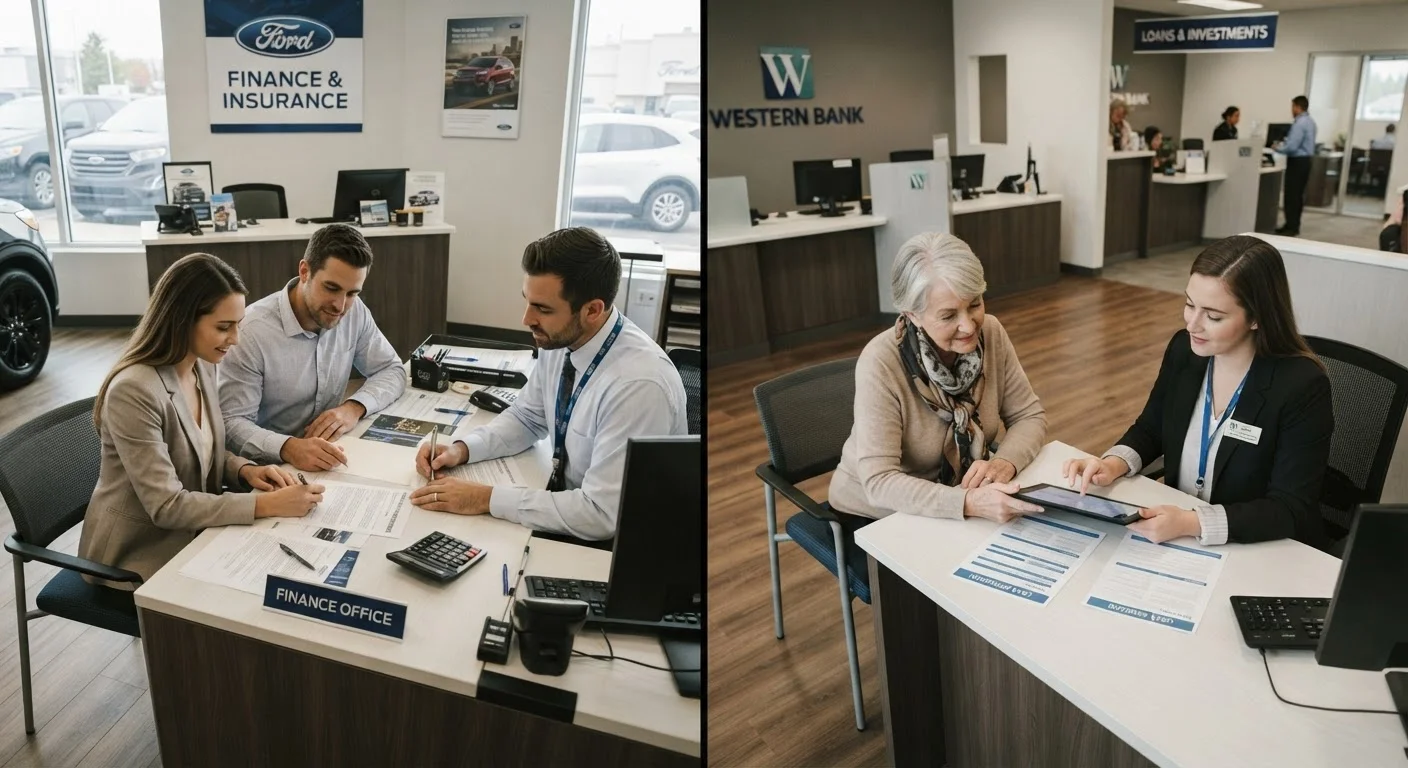
Photo: FaqExplorer.net | Informative Website editorial
Key Takeaways
- Dealers act as intermediaries who mark up rates from lenders - that markup is profit to the dealership.
- Pre-approved bank or credit union loans let you treat the car purchase and the financing as two separate negotiations.
- Manufacturer-subsidized promotional rates (e.g., 0% APR) are only available through dealer financing and can be genuinely valuable.
- Your credit score affects the rate you're offered under both routes, but the spread can differ significantly.
- Comparing both options before signing is the most reliable way to identify the lower-cost path for your situation.
How Each Financing Route Actually Works
When you finance through a dealership, you're not borrowing directly from the dealer. Instead, the dealership submits your application to a network of third-party lenders - banks, captive finance arms (manufacturer-owned lenders), and sometimes credit unions - and presents you with an offer. The lender sets a buy rate (the base rate you qualify for), and the dealer is typically permitted to mark that rate up, pocketing the difference as a financing profit called the dealer reserve. You rarely see the buy rate.
Direct lending works differently. You approach a bank or credit union before visiting the dealership, complete a loan application, and receive a pre-approval letter stating the maximum loan amount and interest rate you've been offered. At the dealership, you use that pre-approval like cash - negotiating vehicle price independently - and then either use the pre-approval or accept dealer financing if it's genuinely lower. See our plain-language breakdown of key auto loan terms for definitions of APR, loan term, and related figures you'll encounter under either route.
Understanding how auto loans work as secured debt - where the vehicle serves as collateral - applies to both financing paths equally.
Rate Structures and Where the Costs Hide
| Criterion | Dealer-Arranged Financing | Direct Bank / Credit Union |
|---|---|---|
| Who sets your rate | Lender buy rate + dealer markup | Lender sets rate directly to you |
| Rate transparency | Buy rate typically not disclosed | Rate disclosed upfront in pre-approval |
| Promotional 0% APR access | Available (manufacturer-subsidized) | Not available |
| Negotiating position | Financing and price often bundled | Price and financing fully separated |
| Processing convenience | All paperwork at the dealership | Requires separate lender application |
| Credit union option | Dealer may include some CUs | You choose your credit union directly |
The most significant structural difference is the dealer markup. Under the Federal Reserve's Regulation B and FTC oversight, dealers must follow fair-lending rules, but the markup itself is legal within limits that vary by lender agreement. Markups of 1-2.5 percentage points above the buy rate have historically been common in the industry.
Credit unions, by contrast, are member-owned nonprofits. They frequently publish rate schedules directly and have no equivalent markup incentive. This transparency doesn't guarantee the lowest rate in every case, but it removes one layer of cost that dealer financing structurally includes.
The exception worth noting: manufacturer-subsidized promotional rates. These are funded by the automaker (not the dealer's profit) to stimulate sales and can include 0% APR offers for well-qualified buyers. These rates are only available through captive lenders accessed via dealerships - a bank cannot match them. If you qualify and the promotional terms apply to the specific vehicle you want, they can represent the lowest-cost option available. Always confirm whether choosing the promotional rate requires forgoing a cash rebate, which may change the math.
1-2.5%
Typical dealer rate markup range
Industry sources and consumer finance researchers have documented dealer reserve markups in this range above the lender's buy rate, though lender agreements vary.
~80%
New car buyers who finance through the dealer
According to J.D. Power and industry reporting, the substantial majority of new vehicle purchasers use dealer-arranged financing rather than a pre-arranged loan.
For a broader view of how dealership dynamics shape overall costs, see why buyers overpay at the dealership.
Practical Strategy: Using Both Routes Together
The most effective approach for most buyers isn't choosing one route in isolation - it's using direct lending as a baseline and then letting dealer financing compete against it. Obtain a pre-approval from your bank or credit union before visiting any dealership. This gives you a concrete rate benchmark and protects you from relying solely on whatever the finance manager presents.
At the dealership, negotiate the vehicle price first, completely separate from financing. Once price is agreed, ask what financing rate the dealer can offer. If it's lower than your pre-approval (factoring in all fees), take it. If it isn't, use your pre-approval. The dealer's finance office has the right to try to beat your rate - and sometimes will.
Your credit profile matters under both routes. How lenders interpret your credit history applies broadly across loan types: payment history, utilization, and length of credit history all influence the rate tier you're placed in. Checking your credit report before applying - through AnnualCreditReport.com - costs nothing and can surface errors worth disputing before they affect your loan terms.
This article provides general financial information for educational purposes and does not constitute personalized financial or lending advice. Consult a qualified financial professional for guidance specific to your situation.
The content on this site is provided for informational purposes only and should not be considered a substitute for professional advice. While we strive to provide accurate and up-to-date information, we make no guarantees regarding its completeness or accuracy. Always consult a qualified professional for advice specific to your circumstances before making any decisions.