
Attic Insulation: Batts, Blown-In, and Spray Foam Compared

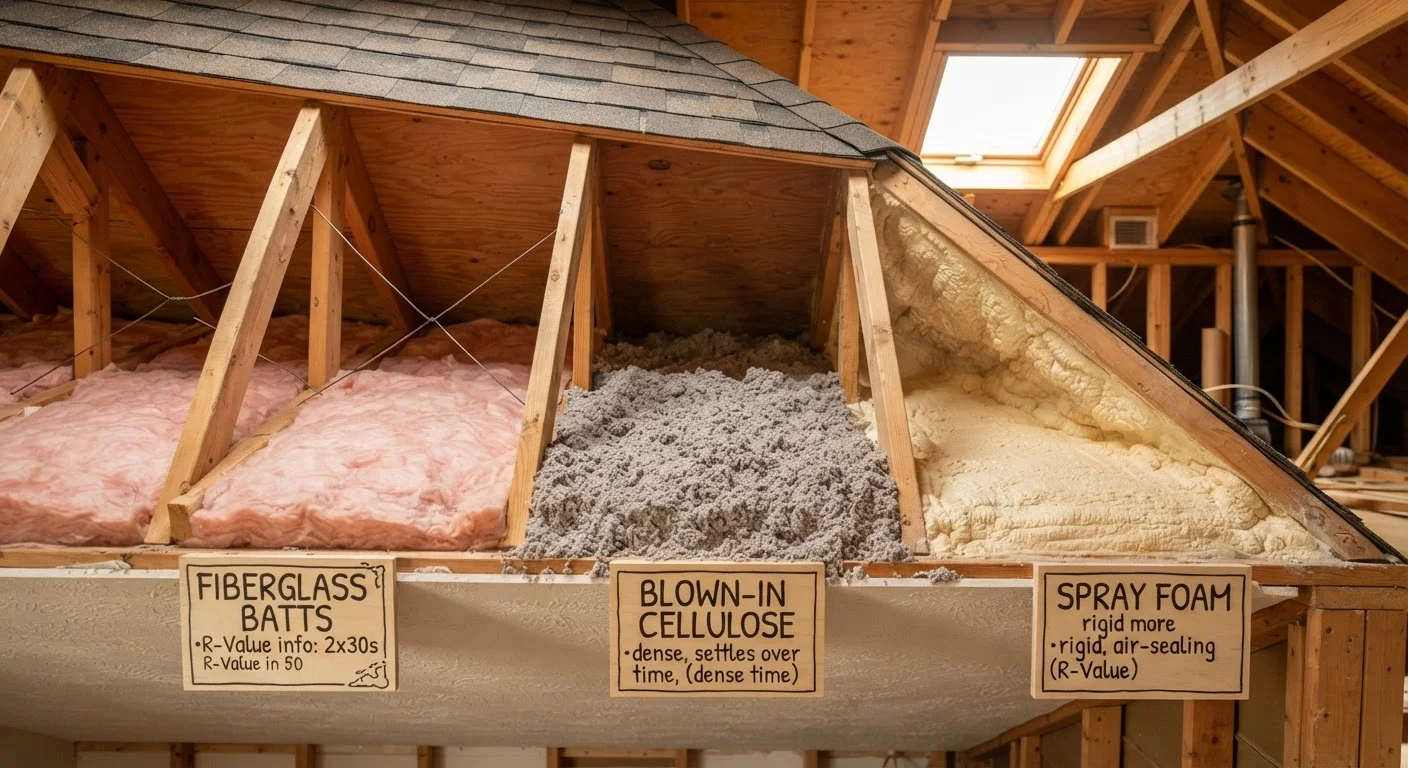
Photo: FaqExplorer.net | Informative Website editorial
Key Takeaways
- Fiberglass batts are the lowest-cost option but require precise installation to avoid air gaps that reduce effectiveness.
- Blown-in insulation conforms well to irregular attic spaces and is a common choice for retrofitting existing homes.
- Spray foam offers the highest R-value per inch and air-sealing in one step, but comes at a significantly higher cost.
- The right insulation type depends on your attic's shape, existing conditions, climate zone, and budget.
- Professional installation is strongly recommended for spray foam; batts and blown-in are sometimes DIY-friendly.
Why Attic Insulation Type Matters
The attic is typically the single largest source of heat loss in a home during winter and heat gain during summer. Choosing the right insulation isn't just about hitting a target R-value - it's about how well that material seals air leaks, fits your attic's geometry, handles moisture, and holds up over time.
R-value measures thermal resistance per inch of material. The U.S. Department of Energy recommends R-38 to R-60 for attics in most climate zones, though the ideal figure depends on your region. All three major insulation types - fiberglass batts, blown-in, and spray foam - can reach adequate R-values, but they differ substantially in how they get there and what else they accomplish. Attic insulation also interacts directly with roof ventilation; poorly paired systems can lead to moisture buildup or ice dams. See our guide to roof ventilation for context on how these systems work together.
Fiberglass Batts: Familiar, Affordable, and Fitment-Dependent
Fiberglass batts are pre-cut panels of spun glass fiber designed to fit snugly between standard joist spacings - typically 16 or 24 inches on center. They are widely available, relatively inexpensive, and familiar to contractors and DIYers alike.
Where They Work Well
Batts perform best in unfinished attics with consistent, unobstructed joist bays and no existing insulation complicating the fit. They're a reasonable choice when attic access is good and the framing is uniform.
Key Limitations
The critical weakness of batts is installation sensitivity. Any compression, gap, or miscut significantly reduces thermal performance. Batts also do not air-seal on their own - penetrations for pipes, wiring, and recessed lights must be separately sealed before installation to prevent conditioned air from bypassing the insulation layer entirely. Moisture can be an issue if batts are improperly faced or installed in humid climates without adequate vapor management.
Seal Before You Insulate
Blown-In Insulation: Versatile and Retrofit-Friendly
Blown-in insulation - available in cellulose (made from recycled paper) or loose-fill fiberglass - is mechanically blown into the attic through a hose, allowing it to fill around obstructions, settle into irregular spaces, and cover existing insulation without cutting or fitting.
Where It Works Well
Blown-in is particularly effective for retrofitting homes that already have partial insulation or attics with nonstandard joist spacing, cross-bracing, or low clearance. It achieves uniform coverage more consistently than batts in complex layouts. Cellulose is treated with borate-based fire retardants and offers slightly better air resistance than loose-fill fiberglass, though neither type provides a true air barrier on its own.
Key Limitations
Blown-in insulation can settle over time, especially cellulose, which may reduce effective R-value by 10-20% after several years. Installation requires a blowing machine and protective equipment; while DIY rental kits exist, consistent depth and coverage are harder to achieve without experience. Air sealing of major penetrations should still be completed before blowing in the material.
| Fiberglass Batts | Blown-In | Spray Foam | |
|---|---|---|---|
| Typical R-value per inch | R-3.1 to R-3.4 | R-2.2 to R-3.8 | R-3.7 to R-7.0 |
| Air sealing capability | None (separate step required) | Minimal | Excellent (integral) |
| Relative installed cost | Low | Moderate | High |
| Best attic type | Open, uniform joist bays | Irregular or retrofit spaces | Conditioned or complex attics |
| DIY feasibility | Moderate | Possible with rental equipment | Not recommended - professional only |
| Longevity / settling | Stable if undisturbed | May settle 10-20% over time | Permanent when cured correctly |
| Moisture sensitivity | Moderate - loses R-value when wet | Cellulose absorbs moisture; treat with care | Closed-cell resists moisture well |
Spray Foam: High Performance, Higher Cost
Spray polyurethane foam (SPF) is applied as a liquid that expands and hardens in place, creating both insulation and an air barrier simultaneously. It comes in two forms: open-cell foam (lower density, lower R-value per inch, vapor-permeable) and closed-cell foam (denser, higher R-value - approximately R-6 to R-7 per inch - and a vapor retarder).
Where It Works Well
Spray foam is best suited to conditioned attic spaces (where the underside of the roof deck is insulated rather than the attic floor), rim joists, and attics with complex framing or significant air leakage problems. Its air-sealing capability makes it especially effective in older homes with many penetrations. Closed-cell foam also adds structural rigidity to roof sheathing.
Key Limitations
Cost is the primary barrier - spray foam typically runs two to three times more per square foot than blown-in insulation. Installation requires licensed professionals working with specialized equipment and personal protective gear; this is not a DIY-appropriate material. Improper mixing ratios can result in off-gassing or foam that fails to cure correctly. Spray foam also makes future inspections of roof sheathing more difficult.
For homes in climates with high humidity, the choice between open- and closed-cell foam has real consequences for moisture management - a factor worth discussing with a building performance specialist before committing.
Making the Right Choice for Your Attic
Before selecting an insulation type, have a contractor or energy auditor assess your current attic conditions: existing insulation depth and type, air leakage points, ventilation setup, and any signs of moisture or mold. These factors can rule out certain options or make one clearly preferable.
Cost Considerations
As a general reference, blown-in insulation typically costs less per square foot than spray foam but more than batts. However, installed cost varies widely by region, attic size, and existing conditions. A professional quote from two or three contractors is the most reliable way to compare costs for your specific project.
Permits and Safety
Most jurisdictions do not require permits for adding attic insulation, but spray foam work near electrical panels, recessed fixtures, or HVAC equipment may trigger local code requirements. Always verify requirements with your local building department. Any work near knob-and-tube wiring - common in homes built before the 1940s - should be evaluated by a licensed electrician before insulation is added.
This article provides general educational information about insulation options and is not a substitute for a professional assessment of your home. Costs, local code requirements, and appropriate product choices vary by location and individual home conditions. Consult a licensed insulation contractor or certified home energy auditor for guidance specific to your property.
The content on this site is provided for informational purposes only and should not be considered a substitute for professional advice. While we strive to provide accurate and up-to-date information, we make no guarantees regarding its completeness or accuracy. Always consult a qualified professional for advice specific to your circumstances before making any decisions.