
How Roof Ventilation Works-and Why It Affects More Than Temperature

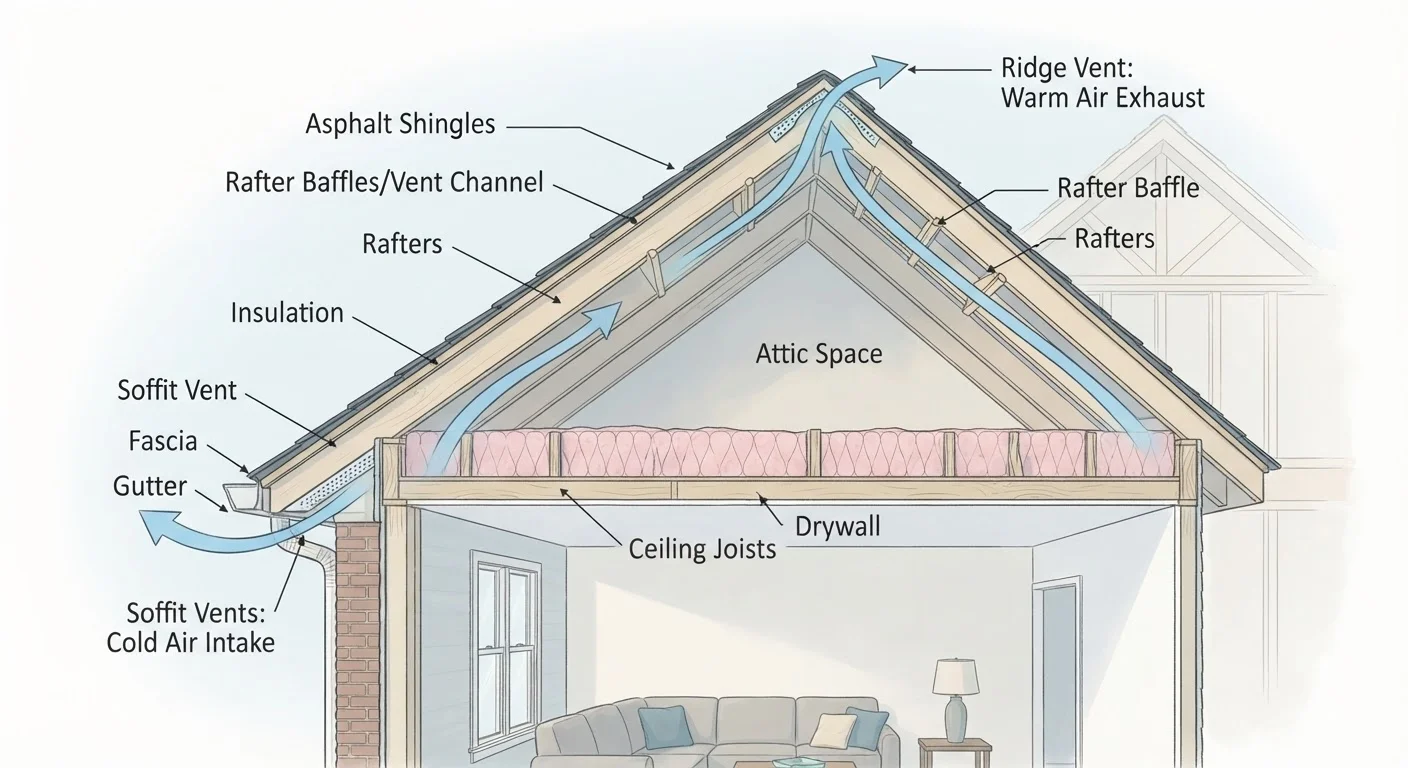
Photo: FaqExplorer.net | Informative Website editorial
Key Takeaways
- Roof ventilation controls both heat and moisture - not just summer temperature.
- Inadequate ventilation accelerates shingle deterioration and can void manufacturer warranties.
- In winter, poor ventilation is a leading cause of ice dams along eaves.
- A balanced system pairs soffit intake vents with ridge or gable exhaust vents.
- Ventilation works best alongside proper attic insulation - the two systems are interdependent.
The Basic Mechanics of Attic Airflow
Roof ventilation operates on a straightforward physical principle: warm air rises. Outside air enters through intake vents positioned low on the roofline - most commonly in the soffits (the underside of the roof overhang) - and travels upward through the attic. Heat and moisture accumulate near the roof peak and are expelled through exhaust vents positioned high, typically a continuous ridge vent running the length of the roof or individual box vents near the peak.
This airflow is passive, meaning it requires no fan or motor under normal conditions. The temperature differential between inside the attic and the outside air, combined with wind pressure, keeps air moving as long as the system is balanced - roughly equal amounts of intake and exhaust area.
When that balance breaks down - blocked soffit vents, mismatched vent types, or inadequate total vent area - the airflow stalls. That stagnation is where problems begin.
Powered Attic Fans: A Note of Caution
Moisture: The Hidden Threat Ventilation Controls
Many homeowners think of roof ventilation primarily as a way to reduce summer heat. In reality, moisture management is its most critical function year-round. Every home generates significant water vapor through cooking, bathing, breathing, and HVAC operation. That vapor rises and, without adequate exhaust, saturates the attic air.
When humid attic air contacts the cooler underside of the roof sheathing, it condenses. Over months and years, that moisture causes:
- Wood rot in rafters and sheathing
- Mold and mildew growth that can spread to living spaces
- Rust on metal fasteners and flashing
- Reduced effectiveness of attic insulation (wet insulation loses R-value)
This is why ventilation and insulation are interdependent systems. Upgrading one without considering the other can produce unexpected results. If you're evaluating your attic insulation, the comparison of attic insulation types is useful context for how insulation placement affects the ventilation strategy required.
1:150
Minimum ventilation ratio per IRC guidelines
The International Residential Code specifies one square foot of net free ventilation area per 150 square feet of attic floor when a vapor barrier is not present.
40%
Insulation R-value loss from moisture saturation
Wet insulation can lose a significant portion of its thermal resistance; the U.S. Department of Energy notes moisture is one of the primary factors degrading attic insulation performance over time.
$5,000+
Typical cost of ice dam water damage repairs
Water intrusion from ice dams - affecting ceilings, walls, and insulation - commonly runs into thousands of dollars in remediation costs, according to general contractor and insurance industry data.
How Poor Ventilation Creates Winter Ice Dams
Ice dams are a direct consequence of uneven roof surface temperatures - and ventilation is central to preventing them. Here's the sequence: heat from living spaces conducts through insufficient insulation into the attic. The warm attic heats the roof deck above, melting snow on the upper portions of the roof. That snowmelt runs downward until it reaches the cold eaves (which overhang the heated space), where it refreezes into a ridge of ice.
As the dam grows, subsequent meltwater backs up behind it and can seep under shingles, into the roof deck, and eventually into interior walls and ceilings. The water damage from ice dam intrusion is often extensive and expensive.
A well-ventilated attic keeps the roof deck uniformly close to outside air temperature, eliminating the warm-upper-roof condition that starts the cycle. Pairing ventilation improvements with air sealing - including measures like sealing gaps around windows and doors - reduces the heat escaping into the attic in the first place.
Impact on Shingle Life and Roof Warranties
Roofing shingle manufacturers generally require adequate ventilation as a condition of their material warranties. The reasoning is direct: excessive heat buildup in an under-ventilated attic raises the temperature of the roof deck far above ambient conditions. That sustained high heat accelerates the oxidation of asphalt in shingles, causing them to dry out, curl, crack, and shed granules years ahead of their rated lifespan.
Industry guidance from organizations such as the Asphalt Roofing Manufacturers Association (ARMA) consistently links inadequate ventilation to premature shingle failure. If a roof fails early and an inspector determines ventilation did not meet code or manufacturer specifications, a warranty claim may be denied entirely.
This makes ventilation not just a comfort issue but a financial one. The cost of correcting ventilation - adding soffit baffles, clearing blocked vents, or installing a continuous ridge vent - is modest compared to a full roof replacement triggered by preventable deterioration.
Check Soffit Vents Before Adding Insulation
What Homeowners Can Do
Start with a visual inspection. In the attic, check that soffit vents are not covered by insulation - this is a common problem during attic insulation projects when batts are pushed too far toward the eaves. Ventilation baffles (rigid channels that hold insulation back from the soffit area) prevent this blockage and are inexpensive to install.
Look at the exterior roofline. Soffit panels should have visible perforations or individual vent covers. At the ridge, a continuous ridge vent will appear as a low-profile cap running along the peak. If your roof uses box vents or turbines instead, confirm they are unobstructed and functioning.
For a definitive assessment, a licensed roofing contractor or home inspector can calculate net free vent area against the attic floor square footage and compare it to code requirements for your region. Ventilation needs also vary by climate: hot-humid climates emphasize year-round moisture control, while cold climates prioritize ice dam prevention. Reviewing this alongside a broader seasonal home maintenance plan helps ensure nothing is missed.
This article is for general informational purposes only. Always consult a licensed roofing contractor or building professional before undertaking roof or attic modifications. Verify local building codes and permit requirements before beginning any work.
Frequently Asked Questions
The content on this site is provided for informational purposes only and should not be considered a substitute for professional advice. While we strive to provide accurate and up-to-date information, we make no guarantees regarding its completeness or accuracy. Always consult a qualified professional for advice specific to your circumstances before making any decisions.