
Debt Avalanche vs. Debt Snowball: Which Repayment Strategy Fits Your Situation

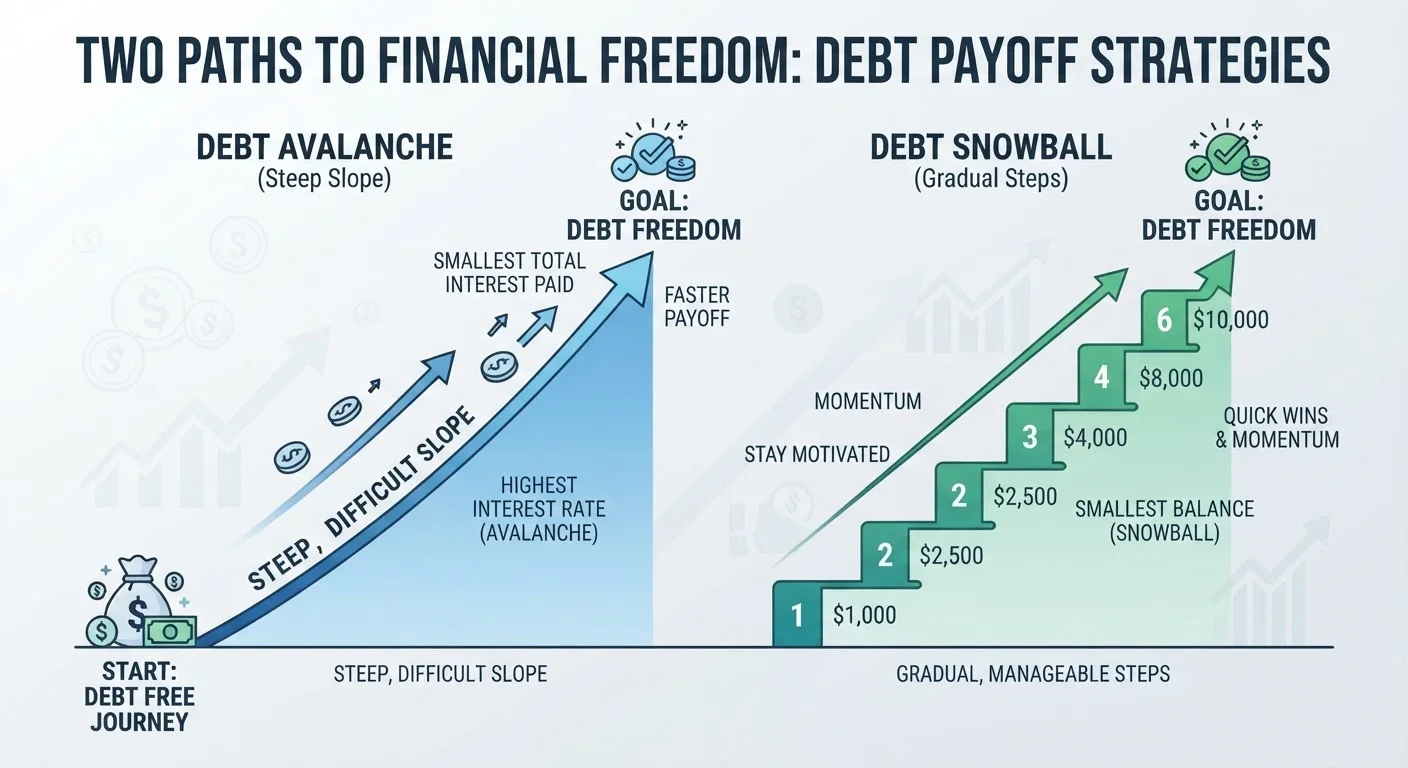
Photo: FaqExplorer.net | Informative Website editorial
Key Takeaways
- The debt avalanche targets your highest-interest balance first, minimizing total interest paid over time.
- The debt snowball pays off the smallest balance first, delivering faster early wins that build motivation.
- Mathematically, the avalanche almost always costs less - but the snowball has strong behavioral advantages.
- Both methods require paying minimums on all other debts while directing extra funds to one target account.
- Choosing a strategy you'll actually stick with matters more than choosing the theoretically optimal one.
- A licensed financial professional can help you evaluate which approach suits your full financial picture.
How Each Method Works
Both the debt avalanche and debt snowball share the same foundational structure: you pay the minimum required on every account, then direct any extra money toward one designated target debt. Where they differ is in how you choose that target.
With the debt avalanche, you rank your debts by interest rate and attack the highest-rate balance first. Once it's eliminated, you roll that payment toward the next-highest rate. Because high-rate debt compounds faster, this sequence reduces the total interest that accrues across your entire debt load.
With the debt snowball, you rank debts by outstanding balance - smallest to largest - and focus on the smallest first. Paying off an account entirely frees up that minimum payment, which gets added to your next target. The accounts accumulate like a rolling snowball of available cash.
Understanding how interest works on each of your accounts is foundational here. For a clear breakdown of the different debt types you may be managing, see our piece on secured vs. unsecured debt - the distinction matters when prioritizing payoff order.
| Criterion | Debt Avalanche | Debt Snowball |
|---|---|---|
| Payoff order | Highest interest rate first | Smallest balance first |
| Total interest paid | Lower (mathematically optimal) | Potentially higher |
| Time to first payoff | Longer (if highest-rate debt is large) | Faster (small balances clear quickly) |
| Motivational structure | Delayed gratification | Frequent early wins |
| Best rate environment | Wide spread between account rates | Rates are similar across accounts |
| Complexity | Low - rank by APR | Low - rank by balance |
The Real Cost Difference - and Why Behavior Matters
The avalanche method wins on pure math. By neutralizing the accounts that generate the most interest, you reduce what you owe over time. The gap in savings between the two methods depends on how spread out your interest rates are: the wider the spread, the more the avalanche saves.
But financial behavior research consistently shows that people who see early progress are more likely to sustain effort over time. A study published in the Journal of Marketing Research found that focusing on eliminating individual accounts - rather than reducing aggregate balances - was associated with higher rates of debt repayment completion. That insight supports the logic behind the snowball method.
~$1,000+
Potential interest savings with avalanche method
Estimated difference can exceed $1,000 on a typical multi-card debt load with varying interest rates, depending on balances and timeline.
3 in 4
Americans carrying some form of debt
Federal Reserve survey data consistently shows the majority of U.S. households carry debt across categories including credit cards, auto loans, and student loans.
In practice, the "best" strategy is the one you'll follow through on. A theoretically optimal plan that you abandon after three months costs far more than a slightly less efficient plan you maintain for two years. If you've struggled with debt repayment before, consider why - the answer may point you toward which method fits your psychology. You can also explore how common borrowing traps may be quietly working against your progress regardless of which method you choose.
Adapting Your Strategy to Your Situation
A few practical considerations can help you decide - or even combine elements of both approaches.
- Review your interest rates carefully. If your rates are clustered close together (say, all between 18% and 22%), the mathematical edge of the avalanche shrinks. The snowball's motivational lift may be worth more in that scenario.
- Identify any accounts with urgent consequences. Some debts carry non-interest penalties - late fees, credit score damage, or legal risk - for falling behind. Minimum payments must be protected across all accounts regardless of strategy.
- Consider a hybrid approach. Some borrowers pay off one or two very small balances first (for the motivational boost), then switch to the avalanche sequence. This isn't textbook, but it reflects realistic human behavior.
- Factor in any consolidation tools. A personal loan that consolidates multiple high-rate balances into a single lower-rate account can change the math significantly. Our article on how personal loans fit into a repayment plan walks through when that makes sense. Separately, debt consolidation has important limitations to understand before pursuing it.
Whichever method you choose, consistency and patience are what ultimately determine success. Both strategies work - the difference is in whether the structure keeps you engaged long enough to finish. If your debt picture is complex or you're unsure where to start, consulting a nonprofit credit counselor or a licensed financial professional can provide personalized guidance tailored to your circumstances.
This article is for informational and educational purposes only and does not constitute personalized financial or legal advice. Please consult a qualified financial professional before making decisions about debt repayment specific to your situation.
The content on this site is provided for informational purposes only and should not be considered a substitute for professional advice. While we strive to provide accurate and up-to-date information, we make no guarantees regarding its completeness or accuracy. Always consult a qualified professional for advice specific to your circumstances before making any decisions.