
Fixed-Rate vs. Adjustable-Rate Mortgages: Understanding the Trade-Offs

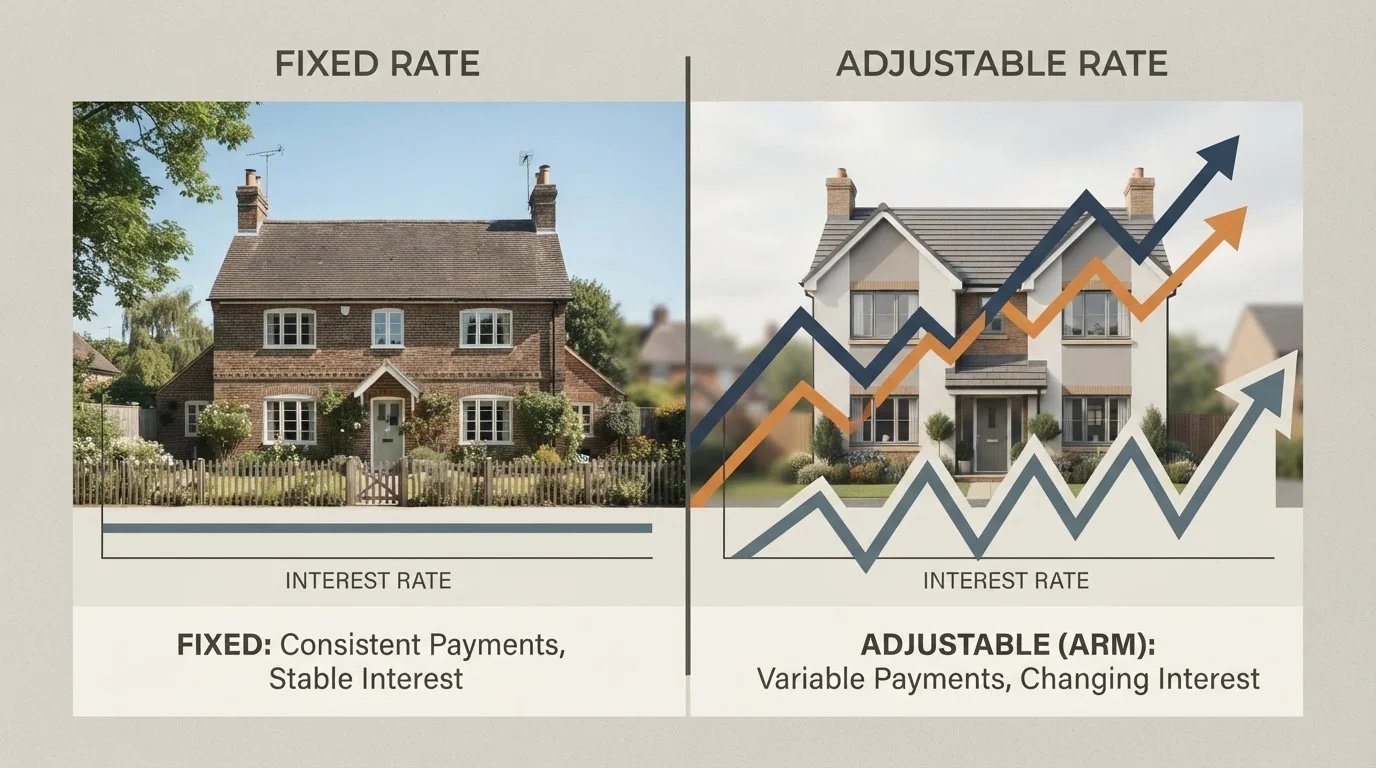
Photo: FaqExplorer.net | Informative Website editorial
Key Takeaways
- Fixed-rate mortgages lock in your interest rate for the entire loan term, making monthly payments predictable.
- ARMs typically offer a lower introductory rate that adjusts periodically after an initial fixed period.
- Your likely time horizon in the home is one of the most important factors when choosing between the two.
- Rate caps on ARMs limit how much your rate can change per adjustment and over the loan's lifetime.
- Credit profile and current market rates both influence which structure offers better value for your situation.
- This article is general financial education - consult a licensed mortgage professional for advice tailored to your circumstances.
How Each Mortgage Structure Works
A fixed-rate mortgage carries the same interest rate for the entire loan term - typically 15 or 30 years. Your principal-and-interest payment stays constant from month one to the final payment, regardless of what happens to market interest rates. This predictability makes long-range financial planning more straightforward, since your largest monthly housing expense never changes.
An adjustable-rate mortgage (ARM) starts with a fixed introductory period - commonly 5, 7, or 10 years - during which the rate is set. After that period ends, the rate adjusts at predetermined intervals (often annually) based on a benchmark index, such as the Secured Overnight Financing Rate (SOFR), plus a lender's margin. A loan described as a "5/1 ARM," for example, carries a fixed rate for five years, then adjusts once per year thereafter.
Understanding this basic structure is foundational to evaluating whether homeownership makes financial sense for your situation at all.
| Criterion | Fixed-Rate Mortgage | Adjustable-Rate Mortgage (ARM) |
|---|---|---|
| Interest rate | Locked for entire loan term | Fixed initially, then adjusts periodically |
| Monthly payment stability | Fully predictable | Can increase or decrease after initial period |
| Initial rate level | Typically higher than ARM intro rate | Often lower than fixed-rate equivalent |
| Best time horizon | Long-term (10+ years) | Shorter-term (under 7-10 years) |
| Rate change limits | None needed - rate never changes | Governed by initial, periodic, and lifetime caps |
| Risk profile | Low - no payment surprise risk | Moderate to higher - payment can rise significantly |
| Common loan terms | 15-year or 30-year | 5/1, 7/1, or 10/1 ARM structures |
Rate Caps, Adjustment Limits, and the Risks ARMs Carry
ARMs are not uncapped. Lenders are required to disclose three types of rate caps: the initial cap (limits the first adjustment), the periodic cap (limits each subsequent adjustment), and the lifetime cap (the maximum your rate can ever rise above the starting rate). A common cap structure is 2/2/5 - meaning the rate can rise no more than 2% at the first adjustment, 2% at each subsequent adjustment, and 5% total over the loan's life.
Even with caps, a meaningful rate increase is possible. A borrower who starts at 5.5% on a 5/1 ARM could legally see their rate reach 10.5% over time under a 5% lifetime cap. On a $400,000 loan balance, that difference translates to hundreds of dollars more per month - a material risk for buyers with limited payment flexibility.
~30 years
Typical fixed-rate mortgage term in the US
The 30-year fixed-rate mortgage remains the most common home loan product used by American buyers, according to federal housing finance data.
5% cap
Common ARM lifetime rate-increase limit
A typical ARM lifetime cap of 5 percentage points above the starting rate is a standard disclosure benchmark required under federal lending regulations.
2-3%
Typical initial rate discount for ARMs vs. fixed
ARMs have historically opened at rates notably lower than comparable fixed-rate loans, though the spread varies with market conditions.
Your credit profile also influences which products you qualify for and on what terms. Borrowers with stronger credit histories typically access lower margins on ARMs and more competitive fixed rates alike.
Choosing the Right Structure for Your Situation
The most useful question is not which mortgage type is objectively better - it is which suits your specific timeline, risk tolerance, and financial situation. If you expect to remain in the home well beyond the ARM's fixed period, the payment certainty of a fixed-rate mortgage generally outweighs the initial savings. If you have a realistic plan to sell or refinance before the first adjustment, an ARM's lower introductory rate can meaningfully reduce your total interest paid during that window.
Market conditions matter too. When prevailing rates are historically low, locking in a fixed rate preserves that advantage indefinitely. When rates are elevated, an ARM may allow you to benefit if rates decline during or after the initial period - though this is not guaranteed and rates can also remain high or rise further.
It also helps to think about how this decision fits within your broader financial picture. The way a mortgage payment behaves each month - fixed or variable - is worth considering alongside how you manage fixed versus variable expenses in your budget more generally. A mortgage is a long-term, secured obligation, and as explained in a companion overview of secured versus unsecured debt, the stakes of default are higher than with unsecured borrowing.
This article is for general informational purposes only and does not constitute personalized financial or mortgage advice. Consult a licensed mortgage professional or financial adviser before making decisions based on your individual circumstances.
The content on this site is provided for informational purposes only and should not be considered a substitute for professional advice. While we strive to provide accurate and up-to-date information, we make no guarantees regarding its completeness or accuracy. Always consult a qualified professional for advice specific to your circumstances before making any decisions.