
OLED vs QLED: What the Panel Difference Means for Your Living Room

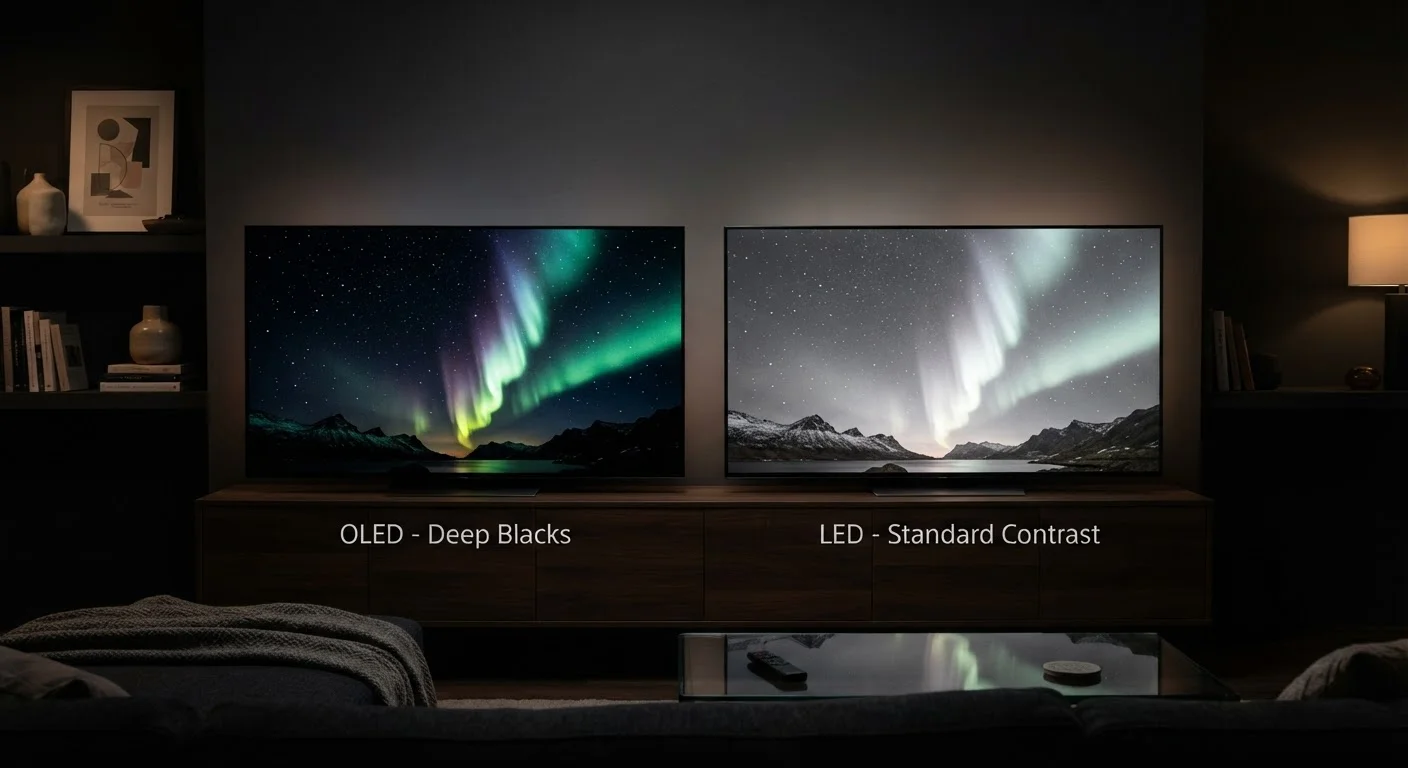
Photo: FaqExplorer.net | Informative Website editorial
Key Takeaways
- OLED pixels emit their own light and can switch off completely, producing true blacks.
- QLED uses a traditional LED backlight enhanced by quantum dots to boost brightness and color range.
- Room lighting conditions are often the deciding factor between the two technologies.
- OLED panels carry a risk of permanent image retention (burn-in) under certain usage patterns.
- QLED panels generally achieve higher peak brightness, which benefits HDR performance in bright rooms.
- Neither technology is universally superior - each suits a distinct viewing environment and habit.
How Each Technology Actually Works
The names OLED and QLED sound superficially similar, but they describe two fundamentally different approaches to producing an image. Understanding those differences - not just reading marketing claims - is the clearest path to choosing the right panel for your home.
OLED stands for Organic Light-Emitting Diode. Each pixel in an OLED panel generates its own light independently. When a pixel needs to display black, it simply turns off. This means contrast isn't engineered around a backlight - it's an inherent property of the display itself. The result is what's often described as infinite contrast: the ratio between the brightest white and a true, literal black.
QLED stands for Quantum Light-Emitting Diode. It is, at its core, an LCD panel - the same category that has dominated flat-panel TVs for years - but with a critical upgrade. A layer of quantum dots (nanoscale semiconductor crystals) sits between the LED backlight and the LCD layer. When backlight energy passes through, the quantum dots re-emit it at very precise, pure wavelengths of color, significantly improving both color saturation and brightness efficiency compared to conventional LED-backlit LCD panels.
For a broader look at how panel type fits alongside resolution and refresh rate, see our display specs primer.
| Criterion | OLED | QLED |
|---|---|---|
| Light source | Per-pixel self-emissive organic diodes | LED backlight + quantum dot layer |
| Black levels | True black (pixel fully off) | Near-black (backlight dimming zones) |
| Peak brightness | Moderate to high | High to very high |
| Contrast ratio | Effectively infinite | High, but finite |
| Viewing angle | Excellent off-axis consistency | Moderate; varies by VA/IPS subtype |
| Burn-in risk | Present under heavy static-image use | No burn-in risk |
| Best room condition | Dim or controlled lighting | Bright or mixed ambient light |
| HDR highlight rendering | Deep blacks enhance perceived HDR | Higher peak nits for bright highlights |
Real-World Performance: Where the Gap Shows Up
Specs on a sheet rarely tell the full story. The meaningful differences between OLED and QLED emerge in specific viewing conditions that map directly to everyday use.
Black Levels and Contrast
In a dark room, OLED's pixel-level shutoff is immediately visible. Dark scenes in films reveal shadow detail without the faint glow - often called blooming - that can appear around bright objects on backlit LCD panels. Even high-end QLED sets using full-array local dimming (which divides the backlight into independently controllable zones) can only approximate this, because zones cover multiple pixels rather than individual ones.
Peak Brightness and HDR
QLED's architecture allows manufacturers to push backlight intensity significantly higher. In rooms with ambient light, this matters: a brighter panel cuts through glare and keeps specular highlights - the dazzling whites in HDR content - looking genuinely luminous. OLED panels have improved considerably in brightness, but many QLED models still sustain higher peak nits over large screen areas.
Viewing Angles
OLED panels maintain their color accuracy and contrast at wide angles - useful when seating isn't centered on the screen. Most QLED panels use VA-type LCD alignment, which tends to show contrast and color shift as viewing angle increases, though some manufacturers address this with optical film layers.
Burn-In Risk
Because OLED organic compounds age with use, pixels that display static elements for extended periods can degrade faster than surrounding pixels, creating permanent image retention. Modern OLED panels include software mitigations (pixel shifting, logo luminance adjustment), and for typical mixed viewing the practical risk is low - but it warrants consideration for dedicated gaming or commercial display use.
∞:1
Theoretical contrast ratio of OLED panels
Because OLED pixels switch off completely to produce black, the measured on/off contrast ratio has no finite ceiling - a key differentiator from backlit displays.
1,000+ nits
Typical peak brightness of high-end QLED TVs
Many flagship QLED models sustain over 1,000 nits of peak brightness, with some exceeding 2,000 nits - enabling strong HDR performance in bright environments.
~10 years
Estimated OLED panel lifespan at normal use
Panel manufacturers commonly cite organic emitter half-life figures suggesting over a decade of daily use before visible brightness degradation at typical home viewing levels.
Curious how resolution interacts with panel type on the same screen? Our TV resolution explainer covers what those numbers actually mean at typical viewing distances.
Matching Panel Type to Your Living Room
Neither OLED nor QLED is a universal upgrade over the other. The right choice depends heavily on three variables: ambient light, content type, and daily usage habits.
A room with blackout curtains, dimmed bias lighting, and a primary diet of films and scripted drama tilts strongly toward OLED. The technology was essentially designed for this scenario - controlled light, deep blacks, cinema-grade contrast. If you also stream a wide variety of content, see our comparison of smart TV platforms and streaming devices to understand how software quality complements your hardware choice.
A room flooded with afternoon sunlight, used for daytime sports viewing or casual TV watching, tells a different story. Here, QLED's brightness ceiling is a genuine functional advantage - images stay contrasty and readable without fighting the room's light. This is also the environment where OLED's contrast edge is least perceptible, because ambient light washes out dark scenes regardless of panel technology.
Heavy, dedicated gaming introduces another variable: static interface elements such as health bars, minimaps, or channel logos displayed for hours at a time create elevated burn-in risk on OLED. Occasional or varied gaming sessions present much lower risk, but marathon sessions on a single game with persistent HUD elements are worth factoring into your decision. Before finalizing any choice, our guide to common TV spec traps outlines the marketing claims most likely to mislead buyers at the point of purchase.
Mini-LED QLED: A Middle-Ground Technology
The content on this site is provided for informational purposes only and should not be considered a substitute for professional advice. While we strive to provide accurate and up-to-date information, we make no guarantees regarding its completeness or accuracy. Always consult a qualified professional for advice specific to your circumstances before making any decisions.