
The Real Difference Between 5G and 4G LTE for Everyday Phone Users

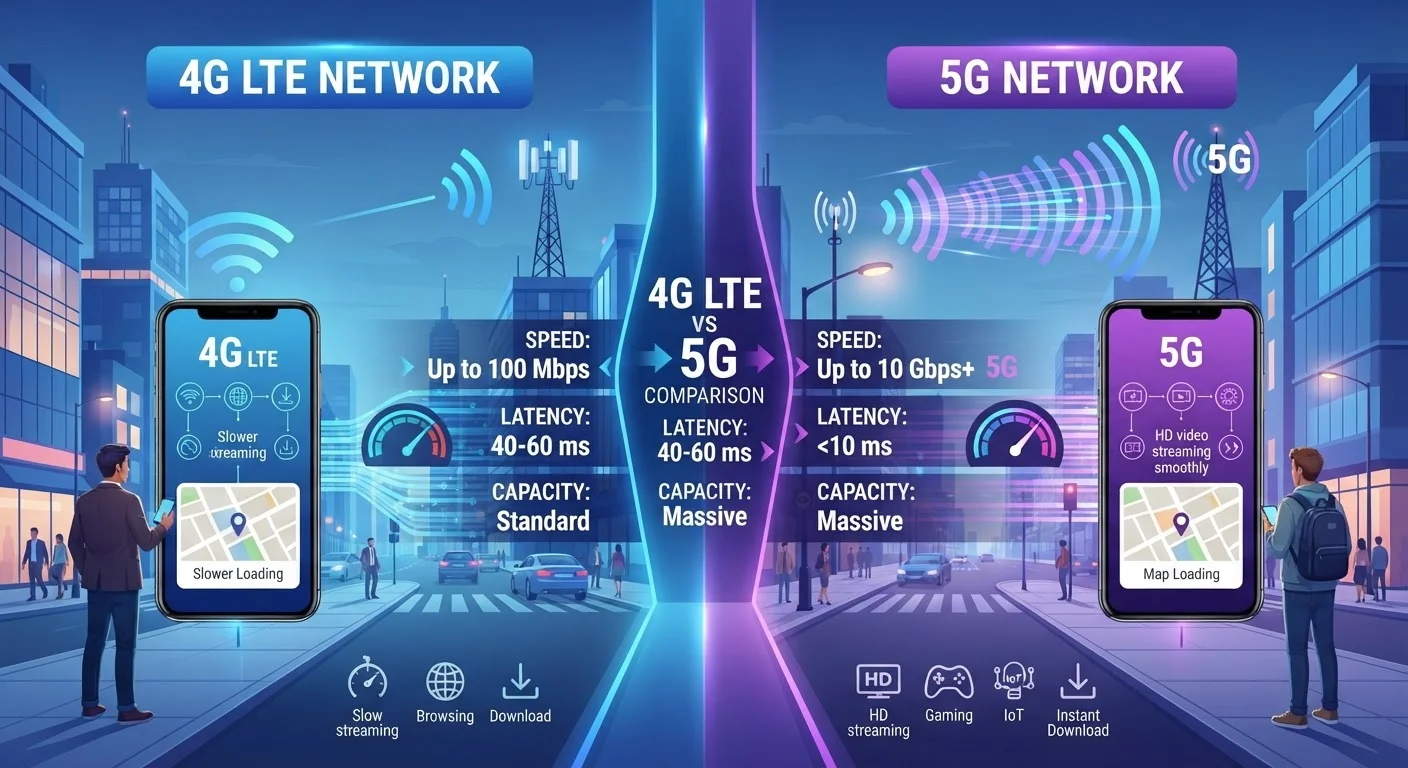
Photo: FaqExplorer.net | Informative Website editorial
Key Takeaways
- 4G LTE remains fast and reliable enough for the vast majority of everyday smartphone tasks.
- 5G offers significantly higher peak speeds, but real-world gains depend heavily on your carrier and location.
- Low-band 5G coverage is widespread but may offer only modest speed improvements over 4G LTE.
- Millimeter-wave 5G delivers the fastest speeds but is limited to dense urban areas and specific venues.
- A 5G phone costs more, but most mid-range and flagship devices now include 5G as a standard feature.
- Your carrier plan and local infrastructure matter more than the network generation label alone.
What 4G LTE and 5G Actually Are
LTE stands for Long-Term Evolution - a technical standard that defines how data is transmitted between your phone and cell towers. When carriers marketed it as "4G LTE," they were describing the fourth generation of mobile networking built on that standard. It became the backbone of smartphone connectivity through the 2010s and still handles the majority of mobile data traffic in the United States today.
5G is the fifth generation, designed to carry more data simultaneously, connect more devices, and reduce latency - the tiny delay between sending and receiving data. But 5G is not a single experience. It operates across three frequency bands, each with different characteristics: low-band (wide coverage, moderate speeds), mid-band (the sweet spot of speed and reach), and millimeter-wave or mmWave (extremely fast, but only within a short range of towers). Understanding which band your carrier deploys in your area is essential context. See our guide to carrier network features for related terminology explained plainly.
Speed and Latency: What the Numbers Mean in Practice
On paper, 5G's speed ceiling is dramatically higher than 4G LTE's. Peak theoretical speeds for 4G LTE typically reach around 100-300 Mbps under good conditions, while 5G - particularly mmWave - can reach multiple gigabits per second. However, theoretical peaks are rarely what users experience.
In day-to-day use, mid-band 5G commonly delivers download speeds in the 100-400 Mbps range, which is meaningfully faster than most 4G LTE connections. Low-band 5G, which powers much of the rural and suburban 5G coverage map, often performs comparably to strong 4G LTE - sometimes only 20-30% faster. For streaming HD video, loading web pages, or sending files, most users will not notice a dramatic difference between solid 4G LTE and low-band 5G.
Latency tells a more nuanced story. 4G LTE typically has latency around 30-50 milliseconds. 5G targets latency below 10 milliseconds, which matters for real-time applications like cloud gaming or video calls - but for ordinary browsing and streaming, this gap is rarely perceptible.
| Criterion | 4G LTE | 5G |
|---|---|---|
| Typical download speed | 25-100 Mbps (real-world) | 100-400 Mbps (mid-band) |
| Typical latency | 30-50 ms | Under 30 ms (often under 10 ms) |
| Coverage breadth (U.S.) | Very broad, including rural areas | Expanding; strongest in urban areas |
| Indoor signal reliability | Generally consistent | Varies by band; mmWave limited indoors |
| Battery impact | Lower drain on older devices | Similar on modern chipsets |
| Device availability | Wide, including older models | Standard on most new mid-range+ phones |
| Future network priority | Maintained but investment slowing | Primary focus of carrier expansion |
Coverage Realities Across the U.S.
National carriers have expanded 5G coverage maps substantially, but the label "5G" on your status bar does not guarantee a consistent experience. Low-band 5G signals - which travel farther and penetrate buildings better - form the foundation of most carriers' broad coverage claims. Mid-band 5G, which delivers the most practical speed upgrade, is concentrated in cities and denser suburban corridors. mmWave 5G is largely confined to sports stadiums, airports, and select downtown blocks in major metros.
4G LTE, meanwhile, has had over a decade of infrastructure investment behind it. Its coverage is more uniform, its indoor penetration is well-understood, and it remains the fallback network when 5G signals are weak. For many users outside of major urban centers, 4G LTE delivers a more predictable daily experience than a patchy 5G connection.
How to Check Which 5G Band Your Carrier Uses
Battery Life, Device Compatibility, and Cost Considerations
5G radios historically consumed more power than their 4G counterparts, but chipmaker and device manufacturer improvements have substantially narrowed this gap in phones released from 2022 onward. In most current devices, the real-world battery impact of using 5G versus 4G LTE is modest - particularly if your phone's software manages radio switching intelligently.
On device cost, 5G is now standard across most mid-range and flagship phones, so buyers rarely face a stark binary choice. The more relevant consideration is whether your carrier plan supports 5G data and whether your local coverage makes that plan worth a potential premium. For a deeper look at what other phone specs actually affect your experience, see our smartphone specs decoder.
One forward-looking consideration: carriers have already begun sunsetting 3G networks. As 4G LTE gradually yields priority to 5G in carrier investment cycles, a 5G-capable phone may remain compatible with evolving network infrastructure longer. Our article on factors affecting phone longevity explores this dimension in more detail.
~300 Mbps
Typical peak 4G LTE speed under good conditions
Real-world 4G LTE speeds vary widely based on tower congestion, signal strength, and device hardware.
10 ms
Target latency for 5G networks
The ITU's IMT-2020 standard sets a 1 ms latency target for 5G; current commercial deployments commonly achieve 10-30 ms in practice.
~80%
U.S. population covered by low-band 5G
Major U.S. carriers have reported broad low-band 5G population coverage, though mid-band and mmWave coverage remains more limited geographically.
The content on this site is provided for informational purposes only and should not be considered a substitute for professional advice. While we strive to provide accurate and up-to-date information, we make no guarantees regarding its completeness or accuracy. Always consult a qualified professional for advice specific to your circumstances before making any decisions.