
Smartphone Specs Decoded: What the Numbers on a Phone Listing Actually Mean

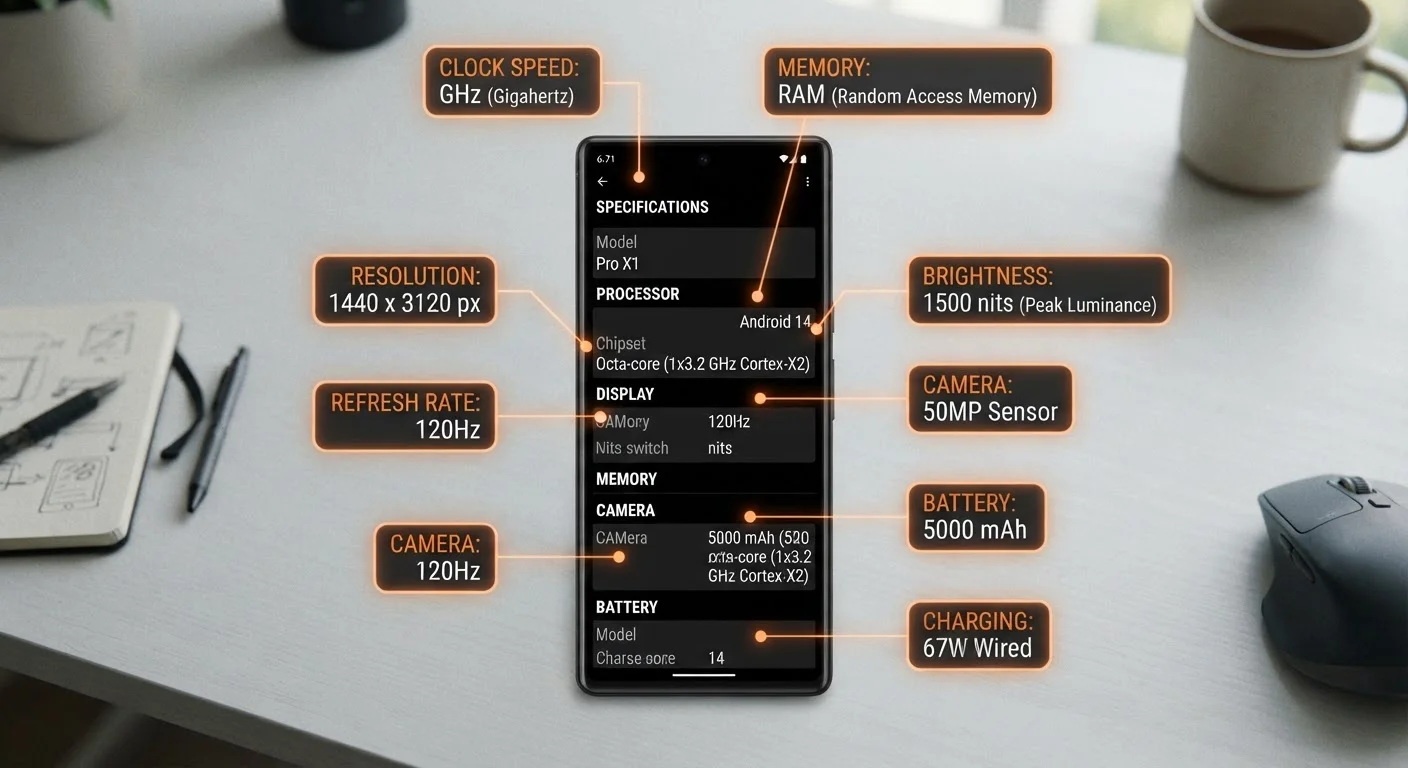
Photo: FaqExplorer.net | Informative Website editorial
Why Phone Specs Feel Like a Foreign Language
Phone listings pack a remarkable amount of information into a small space: 6.7" AMOLED, 120 Hz, 12 GB RAM, 256 GB UFS 3.1, 50 MP f/1.8, 5000 mAh, NFC, IP68. For many buyers, that row of figures is either overwhelming or meaningless. Yet each number describes something real - a capability, a limit, or a trade-off that will affect daily use.
This guide translates the most common specs into plain language. It won't tell you which phone to buy; it will tell you what every number on the listing actually measures, so you can decide what matters to you.
Display: Size, Resolution, and Refresh Rate
The screen size figure (e.g., 6.7") is the diagonal measurement of the display in inches. Larger screens are easier to read and better for video, but add bulk and weight.
Resolution - often listed as 1080 × 2400 or labeled FHD+ - describes how many pixels the screen contains. More pixels generally means sharper text and images, though differences become hard to see above roughly 400 pixels per inch (ppi).
Display type matters as much as resolution. LCD panels are common and energy-efficient in bright light. OLED and AMOLED panels produce deeper blacks and more vivid color because each pixel generates its own light and can switch off completely.
Refresh rate (measured in Hz) is how many times per second the screen redraws itself. A 60 Hz panel updates 60 times per second; 120 Hz feels noticeably smoother for scrolling and gaming. Higher refresh rates do consume more battery, though many phones now adapt the rate dynamically to manage power.
Brightness is measured in nits. A panel rated at 800 nits or above is generally usable outdoors in direct sunlight; displays below ~500 nits can wash out in bright conditions. Peak brightness figures (sometimes listed as 1600 nits or higher) reflect short bursts used for HDR content rather than sustained output.
Processor, RAM, and Storage
The processor (also called SoC, or system-on-chip) is the phone's brain. Listings may show a brand name and model number alongside a GHz figure. The GHz number represents clock speed - how fast the processor cycles per second - but it's a limited proxy for real-world performance. Architecture, core count, and software optimization all matter. For a fuller picture of how chip specs translate to everyday tasks, see common misconceptions about phone processors.
RAM (random-access memory) keeps apps loaded and running. More RAM allows more apps to stay open simultaneously without reloading. Most mid-range phones ship with 6-8 GB; power users or those who multitask heavily may benefit from more.
Storage is where your photos, apps, and files live. This is a fixed number - 128 GB, 256 GB - and it doesn't affect speed the way RAM does. The two are easy to confuse; storage vs. RAM explained in detail covers the distinction fully. Storage type (UFS 2.1, UFS 3.1) affects read/write speed, which influences how quickly apps load and files transfer.
Camera Specs, Battery, and Connectivity
Camera megapixels (MP) measure how many millions of pixels the sensor captures. Higher MP counts allow larger prints and more cropping flexibility, but sensor size, aperture, and image processing software often have a greater impact on photo quality. Reading a full camera spec sheet explains those factors in depth.
Aperture is listed as f/1.8 or f/2.2, and so on. A lower f-number means a wider lens opening, which lets in more light - generally better for low-light photography.
Battery capacity is measured in milliamp-hours (mAh). A larger mAh figure means more stored energy, but actual battery life depends heavily on screen size, brightness, processor efficiency, and software. Charging speed is listed in watts (W); higher wattage means faster charging to full.
Connectivity specs include Wi-Fi standard (Wi-Fi 6 vs. Wi-Fi 5), Bluetooth version, and whether the phone supports NFC (near-field communication) - a short-range wireless technology used for tap-to-pay and pairing accessories. 5G support is now common but varies by band; for a practical breakdown, see the real difference between 5G and 4G LTE.
IP rating (e.g., IP68) indicates dust and water resistance. The first digit (6) means complete dust protection; the second digit (8) indicates the phone can be submerged in water under specific conditions. These ratings are tested in controlled environments and don't cover all real-world scenarios.
SoC (System-on-Chip)
The main processor in a smartphone that integrates the CPU, GPU, modem, and other components onto a single chip. The SoC model is a stronger performance indicator than clock speed alone.
RAM
Random-access memory that temporarily holds running apps and data. More RAM allows smoother multitasking, but it does not increase how much you can store on the phone.
AMOLED
Active-Matrix Organic Light-Emitting Diode - a display technology where each pixel produces its own light. AMOLED screens typically offer deeper blacks and more vibrant colors than LCD panels.
Refresh Rate (Hz)
How many times per second a display redraws its image. Higher refresh rates (90 Hz, 120 Hz) produce smoother motion but can reduce battery life if not managed adaptively.
NFC
Near-field communication - a short-range wireless technology (roughly 4 cm) used for contactless payments, pairing accessories, and sharing data between devices.
IP Rating
Ingress Protection rating - a two-digit code indicating a device's resistance to dust and water. For example, IP68 means full dust protection and submersion resistance under defined test conditions.
Aperture (f-number)
A measure of how wide a camera lens opens to admit light. A lower f-number (e.g., f/1.8) means a wider opening, which improves low-light photography.
nits
The unit of luminance used to measure display brightness. Higher nit values indicate a brighter screen, which is especially important for outdoor visibility in sunlight.
The content on this site is provided for informational purposes only and should not be considered a substitute for professional advice. While we strive to provide accurate and up-to-date information, we make no guarantees regarding its completeness or accuracy. Always consult a qualified professional for advice specific to your circumstances before making any decisions.