
Battery Capacity, Efficiency, and Fast Charging: How Phone Batteries Actually Work

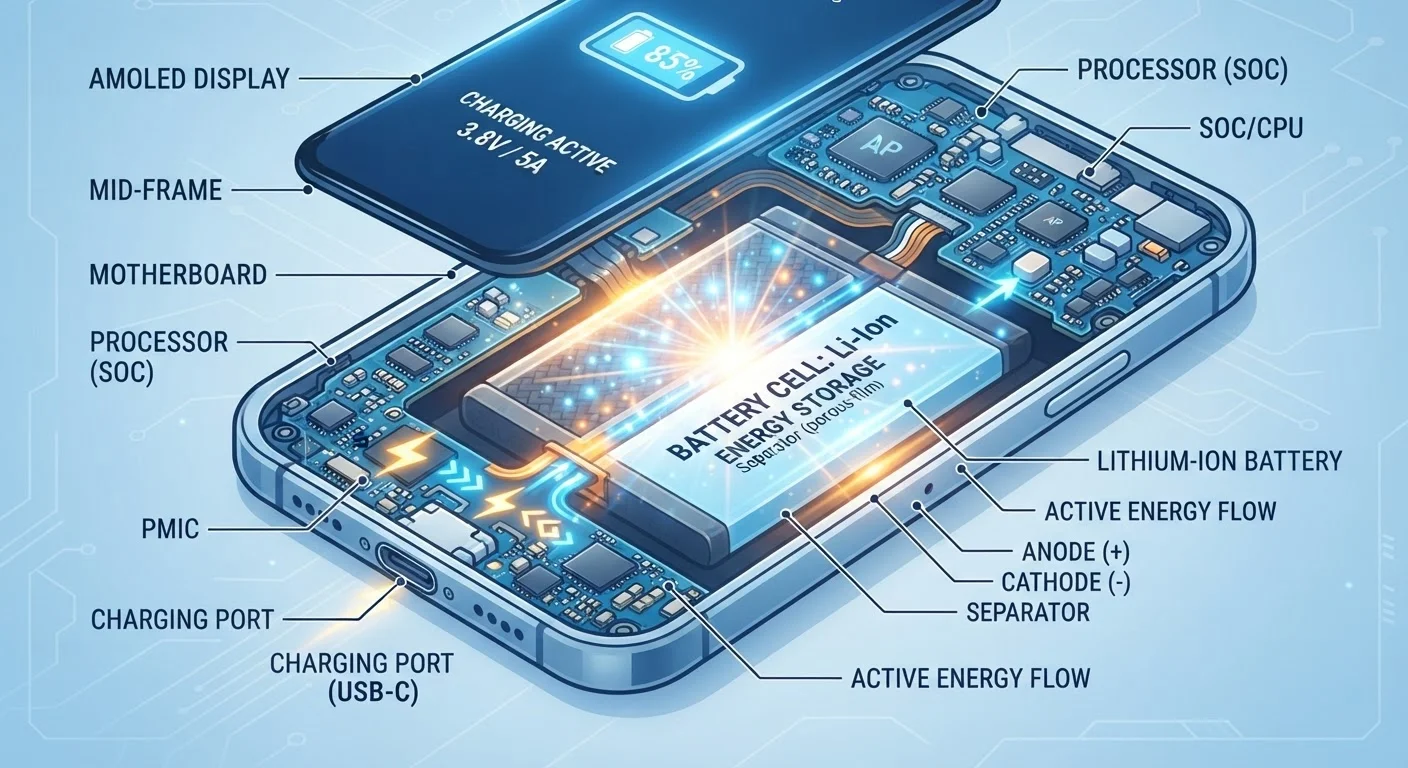
Photo: FaqExplorer.net | Informative Website editorial
Key Takeaways
- mAh tells you how much charge a battery stores, not how long a phone will actually last.
- Processor efficiency, screen resolution, and software all drain battery as much as raw capacity does.
- Fast charging speeds up refueling but does not increase total battery capacity or daily endurance.
- Repeated fast charging at high heat can accelerate long-term battery degradation.
- Manufacturer battery life estimates are measured under controlled, often ideal, conditions.
- Battery health degrades over charge cycles - capacity at 18 months may differ significantly from day one.
What mAh Actually Measures - and What It Doesn't
When scanning a phone's spec sheet, the battery listing usually shows a single number followed by "mAh" - say, 4,500 mAh or 5,000 mAh. It's tempting to treat this as a direct proxy for battery life, but that's an oversimplification that leads buyers to wrong conclusions.
Milliampere-hours measure electrical charge storage - think of it like the size of a fuel tank. A bigger tank holds more fuel, but how far you travel depends on the engine's efficiency, the weight of the vehicle, and how hard you're driving. The same logic applies to phones.
A 5,000 mAh battery in a phone with a 120Hz display, a large screen, and always-on connectivity will drain faster than a 4,500 mAh battery in a compact phone with a 60Hz display and an efficient processor. The spec sheet only tells half the story. For a broader look at how capacity fits alongside other phone specs, see our guide to decoding smartphone specs.
300-500
Charge cycles before significant capacity loss
Industry-standard lithium-ion cell specifications typically cite 80% capacity retention up to this cycle range, after which degradation accelerates.
~20%
Capacity loss possible within two years
Consumer battery testing has shown that heavy daily charging and heat exposure can reduce usable capacity noticeably within typical phone ownership periods.
120Hz vs. 60Hz
Display refresh rate impact on drain
Display testing consistently shows high-refresh screens can consume meaningfully more power during active use compared to standard 60Hz panels at similar brightness.
The Efficiency Equation: Where Battery Life Is Really Won or Lost
Battery life is largely determined by how efficiently a phone's components consume power - and the processor is the biggest variable. Chips manufactured using smaller process nodes (measured in nanometers) perform the same computational tasks while drawing less current. This is why newer processor generations often deliver better battery life even when paired with a similarly sized battery.
The display is the second major drain. High-refresh-rate screens (90Hz, 120Hz) update more frequently than standard 60Hz panels, which consumes more power. Screen brightness, resolution, and panel technology (OLED vs. LCD) all contribute to how quickly the battery depletes during active use.
Software optimization matters too. A well-tuned operating system limits background activity, manages wake locks efficiently, and throttles processes when full power isn't needed. This is why two phones with identical hardware can still show different battery performance depending on the software running on them. The same principle applies to chip behavior - our article on how mobile processors actually work explains how raw specs can be misleading.
Maximize Battery Life With Simple Habits
Fast Charging: Speed vs. Longevity
Fast charging has become a headline feature for many phones, with some manufacturers advertising 65W, 100W, or even higher wattage ratings. To understand what this means, it helps to separate two things: the rate of charge delivery and the total energy stored.
Wattage determines how quickly power flows into the battery - a higher wattage charger refills the battery faster. But it doesn't change the battery's capacity. A 5,000 mAh battery charged at 65W holds exactly the same energy as the same battery charged at 20W; it just gets there sooner.
The tradeoff is thermal. Fast charging generates heat, and heat is lithium-ion chemistry's primary enemy. Most phones manage this with thermal throttling - the charger slows itself down as the battery approaches full capacity, which is why the last 20% of a charge often takes longer than the first 80%. Charging from 20% to 80% is generally the most efficient and least damaging window.
Over time, repeated high-speed charging can contribute to capacity loss faster than standard charging. This doesn't mean fast charging should be avoided entirely - it's a useful tool - but relying on it exclusively every day may affect long-term battery health. For more on how degradation factors into a phone's overall lifespan, see our piece on what determines how long a phone lasts.
Reading Battery Life Claims from Manufacturers
Most manufacturers publish estimated battery life figures - "up to 24 hours of video playback" or "two days of typical use." These numbers are generated under controlled test conditions that rarely match how people actually use their phones.
Manufacturer tests often use low screen brightness, no background app activity, Wi-Fi connected rather than cellular, and light, scripted usage patterns. Real-world use - streaming video at full brightness, running navigation, or keeping multiple apps active - drains significantly faster than lab benchmarks suggest.
Independent reviewers often run standardized battery drain tests (fixed brightness, looped video or web browsing) that produce more comparable figures across devices. These third-party benchmarks are a more reliable reference point than manufacturer claims alone. The gap between advertised and real battery life is a known pattern in consumer electronics - similar to how laptop battery claims are measured, a dynamic explored in detail in our look at how laptop battery life figures are calculated.
Manufacturer Test Conditions Vary Widely
Frequently Asked Questions
The content on this site is provided for informational purposes only and should not be considered a substitute for professional advice. While we strive to provide accurate and up-to-date information, we make no guarantees regarding its completeness or accuracy. Always consult a qualified professional for advice specific to your circumstances before making any decisions.